
- Homeworld:
Rarc - Regions:
Encholia - Taxa:
Animal
Vertebrate
Placentarian
Crestbreather - Diet:
Omnivorous - Height:
1.40m - 1.70m

Encholian
⯈ Description & Anatomy
Encholians are the native intelligent lifeform on Rarc. Based on archeological evidence they must have been a fairly recent evolutionary branch of the Crestbreather family and it is contested whether or not there may be other sophonts related to them or if their phenotype is entirely unique.
They are easily identified by their upright posture, large eyes, broad mouth and spotted skin. Their limbs are somewhat club-shaped as their lower arms and calves have significantly more girth than their upper arms and thighs. Additonally, their extremities are all the same length- possibly an adaptation to their oft-observed climbing behavior. As all rarcian vertebrates, they posess three bony digits at the end of their limbs.
Encholians, similiar to many sophonts, are adapted to use the upper pair as manipulators, and the lower pair for locomotion. Proven to be helpful when almost entirely submerged, their primary breathing orifices are located on cartiligenous "brow"-structures that arch around their eyes.
Through a complex interworking of bones, muscle and cartilage their heads are maluable while housing both their strikingly enlarged facial features and their sizeable brain. This results in their head having only the cranium as a significantly thick bonemass, while their jawbones remain quite thin, yet incredibly dense. While their upper jaw is connected via the palette to their cranium and lower orbits, their lower jaw is split in two and connects via an array of cartilage and dense muscle to the upper. This split lower jaw allows the Encholian to open their mouth incredibly far and is often used to consume food whole, or to keep their young safe within an extendable throat pouch as a parental care strategy.
⯈ Reproduction & Social Behavior
To produce said offspring, encholian tribes will engage in "mating piles"- This procedure is almost ritualistic and happens across all encholian cultures. All fully developed members of a tribe gather clotheless in a well-protected spot, often within the village center, and proceed to accumulate into a mass of writhing bodies. During this, the females cling onto the males and push down on their abdomen using their legs, which results in the males expelling gamede foam. This bubbly proteine-based mixture will soon envelop the entire pile, mixing and matching the genepool as the females absorb the foam through a swollen inverse of their cloakal lining. To avoid inbreeding, mating piles are often strictly cased off to never include relatives in one pile. It is theorized that Encholians do this instinctively through smell.
After a few Trikads following the event, encholian females, being placentarians, will eject their entire placentoid organ after a short period of gestation.
This organ will grow back in time and the process causes only mild discomfort to the individual. The placental ootheca houses a clutch of 5-9 fertilized eggs and is placed in a small, still body of water. After about 3 Dekads, the eggs inside will hatch into the first molt of the encholian life-cycle, the larva. emerging from the ootheca, these aquatic pisciforms will feed on the remains of the placentoid and their egg casings. Growing up in the water and slowly developing their limbs, they will molt several times until they reach a terrestrial adolescent state. Cognizance develops early on in their "Nymph"-state where they are already gillless lung-breathers and can crawl onto land on all fours. During all of this, the entire Tribe is responsible for their upbringing and care.
Generally, encholians have a strong sense of community and will always strive for communal coherence and feel most comfortable with a set role within a tribe. In many of their cultures there is a religious connotation to this behavior as they have a strng proclivity for mystical thinking- Natural phenomena like animal migration, animal behavior, weather events, astronomical observations and even their own life cycle and instinctual behavior are subject to pattern recognition and religious recontextualization. The currently most frequently encountered system of belief based on these exact factors is known as "Ooyanism".
⯈ Relation To Colonists
Eversince the arrival of the colonist species on Rarc, encholians have been driven out of their natural habitats, with special impact on the tribes of central and southern Moli. Most of these tribes have migrated to the tropical island Encholia and its adjacent peninsula, where they have allied themselves and are known as the Eastern Tribes. They are the most well organized and plentiful encholian population known to date, and are projected to become metalurgic within the next 10 years. Frequent altercations following land and resource disputes, misunderstandings and spread of extraterrestrial diseases have lead to the encholians avoiding the Colony and its outposts. Only a few aggressive marauders will enact raids on remote colony stations, oftentimes vandalizing or breaking buildings and machinery. If colonists come too close to an encholian village or encampment they are usually met with strong resistance to their presence and run the risk of severe injury or death. The Central Colony Council has therefore advised all traveling entrepeneurs to stay clear of wooded areas and encholian architecture.

- Homeworld:
Rarc - Regions:
Moli Caverns
Gondorma Clusters - Taxa:
Animal
Vertebrate
Placentarian
Probiscid - Diet:
Omnivorous - Size:
10cm - 20cm

Spud
⯈ Description & Anatomy
Spuds are subterranean Probiscids that live in large colonies of up to 100 individuals. They feed predominantly on Munge-Fungus, small invertebrates and carrion.
Their body shape is suited well for tunneling, while their appendages are multifunctional and can perform both digging and climbing tasks, making them ideally adapted to the cavernous underground of Moli.
Small sensory hairs on their abdomen allow them to move backwards as they would forwards, even their hind legs have specifically been adapted for this behavior. Their orientational sense is unparalleled and it is theorized that they utilize Rarc's magnetic field to navigate instead of relying on reference points in their environment.
Their eyes have atrophied to a point of being nearly blind, though still useful as simple photoreceptors.
The characteristically proboscid trunk is retractable and comparitively thin. Its tip is hardened and spine-like, while multiple small barbs adorn the underside. This spear-like configuration helps in ripping apart munge fungus and carrion. While retracted, the trunk is saturated in an acidic digestive fluid produced from multiple glands in their facial folds- this slowly turns the food source into a slurry that the Spud will suck up once fully liquified.
Spuds are fairly social, although not much can be said for complex problem-solving abilities or altruistic activity.
⯈ Relation to Sophont Factions
Fried, grilled or charred Spud is an encholian staple and has been adapted into Central Colony cuisine. They are easy to come by and catch, providing a cheap morsel for colonists on a budget.

- Homeworld:
Rarc - Regions:
Encholia
Keburo
Oongloii - Taxa:
Animal
Vertebrate
Placentarian
Probiscid - Diet:
Omnivorous - Size:
0,80 - 1.00m
Pyrtle
⯈ Description & Anatomy
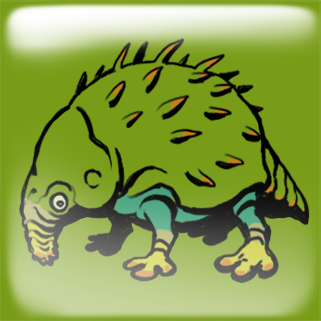
Living in small social groups from five to eight members, the Pyrtle are mostly passive foragers. They prefer the humid thickets of northern Ortelia such as the characteristic forests of Keburo and Oongloii. Their probiscid anatomy provides them with an articulate, muscular trunk that is used to dig & forage for tubers, roots and small animals.
Pyrtle are suprisingly intelligent and adaptive, which reflects in their communal parenting and teaching behavior.
The soft papillae on their backs act as sheathing for long, cartilaginous spines which can be extended in case of threat. The retractability is theorized to be useful when mating, to ensure the safety of participants.
They are most active at dawn and dusk, to avoid predation by both nocturnal and diurnal predators. In their plentiful times of rest, they dig themselves into small ditches and holes, typically leaving only their trunk exposed for breathing.
⯈ Relation to Sophont Factions
Pyrtle have been one of the few species known to be domesticated by multiple Encholian tribes, serving as a steady source of protein during Falter. Traditionally the communal Pyrtle-pen is kept at the center of the Encholian village and is guarded by the whole community.

- Homeworld:
Rarc - Regions:
Encholia - Taxa:
Animal
Vertebrate
Placentarian
Crestbreather - Diet:
Omnivorous - Height:
1.40m - 1.70m
Tilbee
...

- Homeworld:
Rarc - Regions:
Encholia - Taxa:
Animal
Vertebrate
Placentarian
Crestbreather - Diet:
Omnivorous - Height:
1.40m - 1.70m

Herbilon
...

- Homeworld:
Rarc - Regions:
Moli Desert - Taxa:
Animal
Invertebrate
Sessilite
Radialid - Diet:
Carnivorous - Height:
1,80m - 2,00m (Female)
6,00m - 7,00m (Male)
Craq
⯈ Description & Anatomy
Craq have descended from deep-sea Sessilites that are theorized to have been among the first complex animal species that moved onto Rarc's primordial landmasses. These proto-craq are presumed to have looked more worm-like, similar to juvenile Craq.
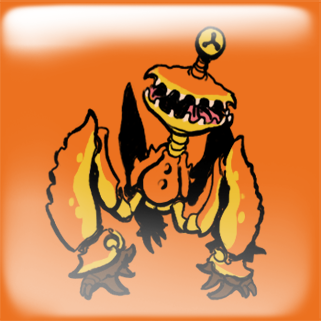
Their radially symmetrical body-plan is paramount to their omnidirectional movement patterns and is only broken by their eyestalk, which has to turn in order to perceive using the oddly shaped, triangular pupil.
The cymbal-shaped upper and lower jaws are connected in the middle by a thick muscular strand, that serves as both the opening mechanism and esophagus. Craq are passive hunters that bury themselves almost entirely with their maw left open, in order to use it as a sort of honey-trap. Obscured by the desert sand, their fragrant saliva lures small organisms between their jaw-discs which are then caught within once the Craq shuts the trap by clenching the discs together. Strong digestive acid is then sprayed onto the prey and small ripples within the oral musculature transport the softended remains toward the esophagal column, where the food is swallowed through small openings between jaw-muscle strands.
⯈ Behavior
Craq lack complex intellect and behave entirely on reflex & instinct. They lack a brain, instead they use multiple nerve nodes that are spread between their four legs and abdomen to process sensory information. Despite this, the thick, spiny exoskeleton is covered in thin hair that is incredibly sensitive to touch and vibration- A Craq can sense movement across the desert for miles, this sensitivity is amplified when buried.
Although they are mostly sessile, Craq are known for being quick and ferocious fighters when threatened or cornered. This behavior has likely developed due to predation from Terraterantolyx, which are best deterred with brute force - During these fits of defensive flailing and when stressed heavily Craq tend to wildly spray highly concentrated digestive acid at the attacker.
⯈ Reproductive Cycle
However, if left buried undisturbed and well fed for over 10 years, a Craq will slowly grow and undergo a drastic transformation into a fully sessile male. These desert behemoths will no longer move about and are able to survive several Dekads without food as their metabolism grinds to a near-halt. In this stage the mobile females will be attracted by the low hum that males emit under the sands and will flock to them in order to mate.
Craq egg-clutches are then laid a meter deep into the sand of Pyorna Groves and covered up, where the temperature stays mostly stable.
After about two Trikads the young Craq-grubs will emerge and radiate out from the clutch, avoiding each other and any adult they come across as they are incredibly vulnerable to cannibalism. After several molts their exoskeleton will have hardened enough to provide them with a set of jaws capable of hunting for themselves. Before this, they mostly filter feed on microscopic organisms living in the sand surroundi9ng the Pyornas, which in turn renews the soil within the grove.
⯈ Relation to Sophont Factions
Encholians revere the Craq as the desert sentinel, but also fear them as they perceive them to uniquely exempt from Straatis' wrath. Hence they are often used as a symbol of resilience, defiance and the way of the warrior. The Craq also stands as one of the guiding animals in Ooyanism.
In steep contrast, the Colonists see Craq as a desert pest and danger to traveling settlers, as large groups of migrating females have more than once ravaged plantations and energy farms placed in the desert.

- Homeworld:
Rarc - Regions:
Keburo - Taxa:
Animal
Invertebrate
Mollistid - Diet:
Herbivorous - Height:
20cm - 25cm

Keeble
⯈ Symbiosis
Keeble play an indispensible role within Rarc's greater ecosystem- Their complex lifecycle is what drives the spread of plantlife on the northern parts of Ortelia.
Female Keeble, sometimes called Keeble fairies, lay their eggs into the seedpods of matured Keeble trees, leaving the characteristic "face"-shaped incision scar on the pod.
As the egg hatches inside, the pod is dropped from the tree following an exchange of pheromones between the hatchling and the plant. The young male Keeble then digs its tentacles through the outer shell of the seed and will start moving, effectively mobilizing the plant while using its sturdy bark as armor.
This perfect symbiosis continues as the Keeble will instinctively start collecting carcasses, mulch and other nutrient-rich materials in large piles around its point of origin, while the bulb provides the animal with glucose.
Gradually this will expand a territory of fertile ground around where the Keeble is active. Keeble have been observed to work in organized groups of countless indivduals, while it is uncertain if their efforts are communicated between the animals or fully instinctual and therefore "automated".
⯈ Reproductive Cycle
After a lifespan of about one Dekad, the male Keeble will slowly begin to seize operation and move to a secluded place within the territory to dig itself into the ground where it will release mating pheromones. This summons a Keeble fairy to the site, with which it will mate through the open "face" of the bulb. After insemination the male will then die. The remaining plant-part of the Keeble symbiosis will at this point take root and use the Keeble's body and fertile ground beneath as nutrients to grow into a mature Keeble-Tree, which will eventually grow seed pods to renew the cycle.
Being Haplo-Diploid, Female Keeble have full control over which gender their descendants will have. After mating, they keep the sperm saved in a specialized organ and will selectively birth either males using unfertilzed eggs and females using fertilized eggs.
Eggs containing female Keeble will typically be layed in small clutches on the inside of the cup-shaped Keeble leaves.
A single Keeble Fairy can have up to 50 male and 20 female descendants in her roughly 2-Dekad lifetime.
⯈ Relation to Sophont Factions
Keeble are deeply sacred to the Encholians of the Keburo region and are fiercely protected by them. Only the forest guide M'ha K'ihltah and her followers (Skullmuggers) are allowed to feed on them as part of the natural cycle. Any other animal or sophont will be attacked by the resident tribe if they attempt to interefere with Keeble activity. Encholians see Keeble as direct agents of Oondis, as they create life from death and raise forests in their wake. In ancient times even the Moli & Dor tribes would travel to Keburo to bury their dead in long processions known as Keeble-Drives. During these, all warfare among tribes was suspended until the tribes had returned back to their villages. Today, remnants of these drives are found in the region in form of Statuettes and scultpures to honor the fallen tribesmen and women.